BLOG POST
Do Record Weights Improve Sound Quality? Why Our Top Performer Weighs Almost Nothing!
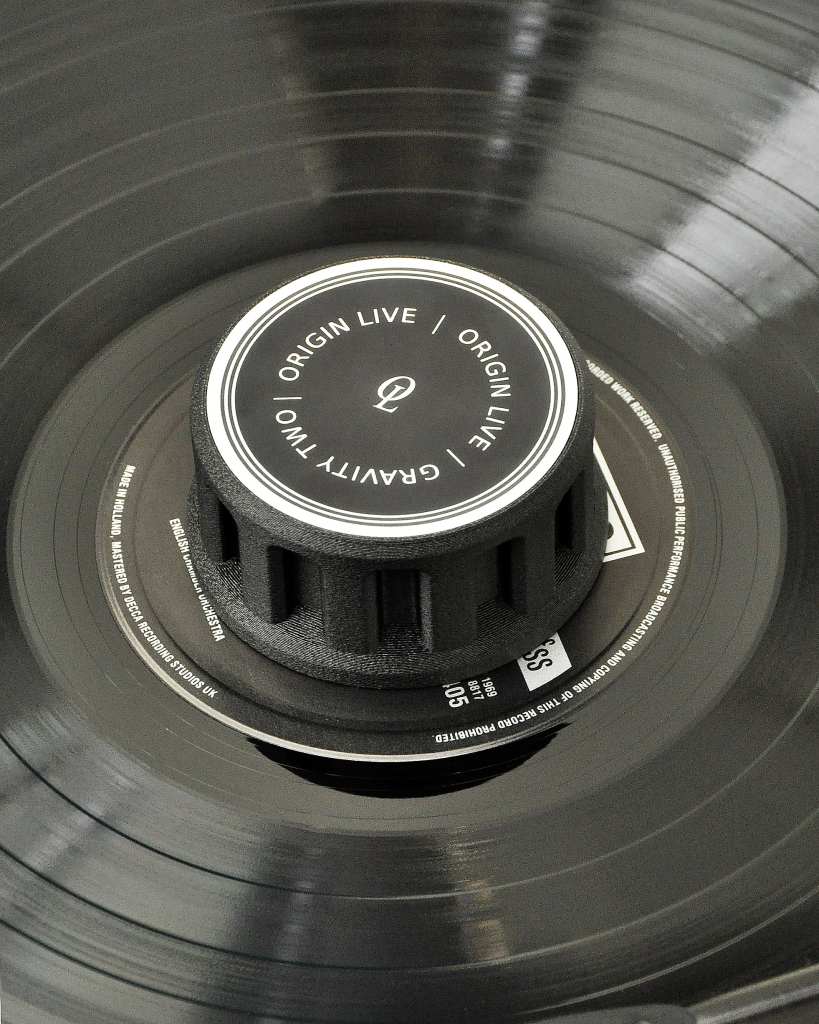
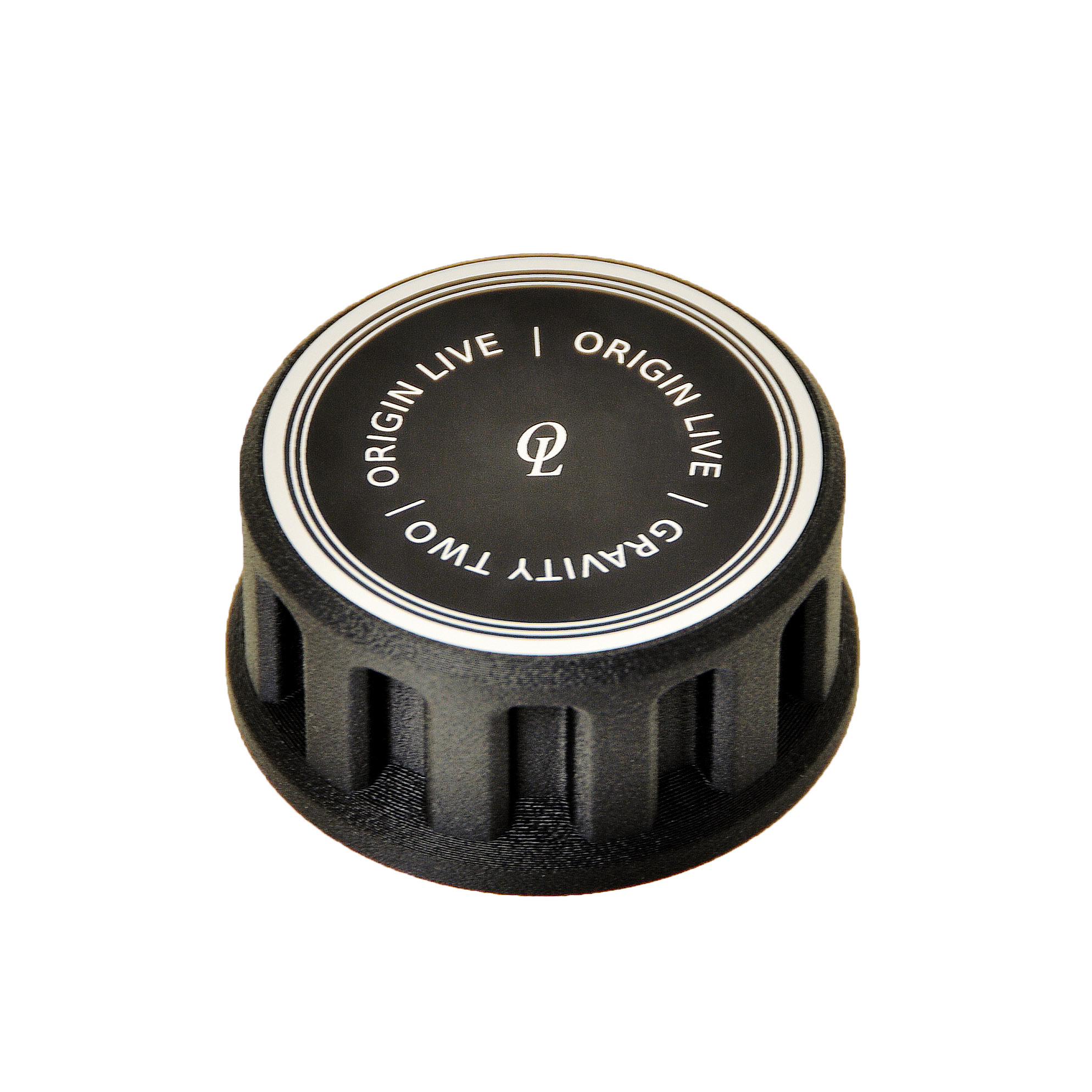
Pick up almost any record weight on the market, and the first thing you notice is the heft. Most are dense lumps of metal, 300 grams, 500 grams, sometimes more than a kilo. The Origin Live Gravity Two weighs 70 grams. Roughly the weight of a chocolate bar.
People reasonably ask why. The answer is the result of five years of prototyping, several hundred listening sessions, and a quiet revolt against an idea the hi-fi industry has clung to for decades: that heavier is better.
What does a record weight actually do?
There are only two honest reasons to put anything on top of a record.
The first, and most common, is to flatten a warped record, so the cartridge isn’t constantly chasing the surface, and the vertical tracking angle stays consistent across the side. This is uncontroversial and generally the goal of the majority of weights & clamps on the market.
The second is to improve the sound by managing the vinyl’s vibration. This is where every weight on the market gets it wrong.
Why does a record vibrate during playback?
Look closely at the contact point between a stylus tip and the groove wall. The accepted figures for the pressure at that point sit somewhere between 1.2 and 8 tons per square inch – numbers that sound absurd until you remember the contact area is smaller than a human hair.
Now factor in speed. A stylus tracking high-frequency information is moving back and forth at up to 50,000 cycles per second (20,000 in most cases). Momentum is mass times acceleration, and at those speeds, even a feather-light tip is hammering the groove walls with serious force.
The result is that the record surface is being mechanically excited into vibration every time the stylus tracks it. That vibration radiates outward across the vinyl in ripples. High frequencies as fast, tight ripples, lows as long, slow ones. These vibrations can reflect and travel back towards the stylus, which causes issue for the fidelity with which your cartridge can track the groove. And if we have something affecting fidelity at input, it’s a given that this will affect our output once the signal reaches the speakers.
The cartridge signal is amplified roughly 8,000 times before it reaches the speakers. So no, it isn’t a small problem, and it isn’t one the record player can solve on its own. Even a turntable with perfect isolation from floor noise, motor noise, and acoustic feedback would still face this problem, because it originates at the stylus itself.
Two schools of thought: Mass/Suction vs Transmission and Dissipation
Once you accept the record is vibrating, the question becomes what to do about it. Broadly, there are two approaches.
The suction approach. Pull the entire record flat against the platter with a vacuum, eliminating any movement. Rockport tried this 40 years ago. Some manufacturers still do — there are decks at £70,000 built around the idea. The problem is that perfectly bonding the record to the platter assumes the platter itself isn’t vibrating. It always is. The bearing the platter is mounted on has friction, motors make noise, and now you’ve created a rigid pipeline feeding all that energy straight into the vinyl and back up through the stylus.
The reputation of these systems bears this out. At a recent Munich show, an audiophile sought advice from Origin Live about his £70,000 vacuum deck. He described it as “dull, lifeless, sterile.” The verdict, regrettably, was that the problem was largely beyond fixing. Vacuum systems suck the noise out of a record. They also suck out the delicacy of the music.
Mass in the weight and platter essentially do the same thing as suction, coupling the vinyl record to the platter with a large weight. Make no mistake, we are not against mass in our design philosophy, but it has to be applied in the right places. The vibration created by the pressure of playback needs to travel away from the record. Many listeners think that coupling the record to the mass will sink the vibrations into the mass, but the truth is that the mass will not transmit the vibrations away fast enough and not across the entire frequency band. Mass is great at the end of a transmission chain, but not at the beginning. When excess energy doesn’t have a chance to escape away from the cartridge, it has no option but to travel back in. This may result in a benefit to bass – since the stylus may travel with increased force side to side, but it comes at the cost of diminished top-end openness and a dull mid-band.
The transmission and dissipation approach. Let the record vibrate, it has to vibrate somewhere – but absorb the vibration at the centre so it dissipates harmlessly rather than reflecting back into the stylus. This is what a properly designed record weight does. It gives the energy somewhere to go.
The trick is doing this without killing the music in the process. Which is harder than it sounds.
How we found light record weights improve sound quality,
For most of Origin Live’s history, founder Mark Baker dismissed record weights entirely. Every time he tried one, the bass would improve, and everything else would suffer, the midrange would close in, the timing would slow, the top end would lose its air. It always felt like a trade-off, never an upgrade.
The change came at a hi-fi show. Origin Live was sharing a room with Martin Brewster of Revelation Audio, the importer of Shun Mook, who had brought along their record weight, a small, comparatively light object that now retails for around £3,800. Listening to it for the first time was a shock. It made the record sound better with no obvious compromise.
Two things stood out. It was light. And it clearly wasn’t trying to flatten the record — it was conditioning it. That was the moment the assumptions began to come apart.
Why 70 grams is the sweet spot
Years of prototyping followed. Many of the early attempts were heavily packed with mixed ball bearings, exotic fillings, and layered metal. The temptation to chase mass is real because mass does deliver bass.
But across hundreds of listening sessions and prototypes, one number kept emerging: 70 grams. Go heavier, and the midrange compresses, the treble loses openness, and the music’s life drains out. Go significantly lighter, and there isn’t enough damping authority. Either side of that figure, the sound moved in the wrong direction.
This is, in retrospect, why so many heavyweights on the market sound the way they do. They’re optimising for the one thing that’s easiest to hear in a demo — bass impact — at the expense of everything else.
A useful test track during development was Minnie Riperton’s Lovin’ You. She has a five-octave range and reaches into the whistle register on that recording. When mass was added beyond 70g, the entire frequency spectrum shifted downwards. The bass got fuller, but Riperton stopped sounding like Riperton. The air and openness in the upper register — the thing that makes that recording extraordinary — collapsed.
That kind of loss isn’t subtle once you know to listen for it.
Layer technology: why no single material works
The second breakthrough came from working with industry veteran Tony Sharman, who pushed Origin Live toward an approach he called Multi- layer technology.
Hi-fi has a recurring weakness for miracle materials. Carbon fibre, beryllium, Delrin (known industrially as POM-C or to us Acetyl and treated by much of the industry as a near-mystical damping compound). All of them have good properties. None is a complete answer on its own.
The principle behind layer technology is straightforward: two materials that resonate at different frequencies, brought into contact, cancel each other’s resonance. It’s mechanical destructive interference rather than acoustical. The Gravity Two stacks multiple layers: lightweight metallic parts with precision-cut profiles, wood, composites, and polymers. Each is chosen for its resonant frequency and its interactions with its neighbours.
Crucially, it’s not relying on any single layer of suspension or absorption to do all the work. The energy passes through a sequence of mismatched layers, losing coherence at each interface, until what reaches the top of the stack is so dissipated that it cannot reflect back into the record.
This can’t be properly modelled. You could theoretically run Fourier analysis on every layer combination, but the simulation space is enormous and — in practice — the model and the listening result usually disagree. The only honest method is to build it, listen to it, and iterate. Which is exactly what happened, for five years between two versions.
From Gravity One to Gravity Two
The Gravity One did what it set out to do: it improved the sound without taking anything away. For a long stretch, it sat at the top of Paul Rigby’s The Audiophile Man comparison reviews, where he had pitted it against around 15 other weights.
Then Stack Audio released a rival lightweight design that briefly overtook it by a narrow margin, the Serene Stabiliser. As fortune would have it, Origin Live was already deep into developing the Gravity Two. Not as a reaction to the Stack Audio Serene, but because we knew the Gravity One still had headroom. At launch, the performance gains from our research and development enabled the Gravity Two to reclaim the top spot.
Several things changed between the Gravity One and Two:
Fewer components. The Gravity One had ten internal parts; the Gravity Two has eight. Every part is a potential transmission and reflection path for vibration, so fewer is generally better — provided each one is the right thing.
Fewer screws. Nine in the Gravity One, four in the Gravity Two. Same reasoning.
A new outer body. The Gravity One contacts the record only at the centre. The Gravity Two adds a refined outer body (made from an anti-resonant polymer that, unusually for the industry, isn’t Delrin), which also makes contact with the record surface and helps absorb vibration. The outer case is also made with additive manufacturing (fancy talk for 3D printing) with structural profiling that increases rigidity, as well as vibrational transmission and dispersion.
That last change was, frankly, an accident. Chief engineer Luke Baker was experimenting late in the prototyping phase and tried bringing the outer case into contact with the record. It went against the structural design philosophy that the rest of the design had been built around, but it also sounded clearly better. The team kept it.
What reviewers actually hear
In his review of the Gravity Two, Paul Rigby noted that music became “much more coherent” with a clear reduction in noise and vibration. High-frequency hash no longer filled the gaps in the music or distorted the presentation. Midrange and treble were clearer, with a slight edge removed from the upper mids. Guitars and secondary percussion sat in sharper focus. Vocals had better diction, lyrics that had previously slipped past were suddenly intelligible. The stereo image was solid and tightly focused, and the bass offered more impact.
The best result is the one most people find counterintuitive. A 70-gram weight has no business delivering a more natural bass impact with greater decay. But what it’s doing is removing the noise and resonance that mask low-frequency detail — so the bass that’s already on the record finally arrives intact, rather than fighting through a haze of upper-frequency hash.
Try it
The Gravity Two is £230 and comes with a 30-day money-back guarantee. Origin Live stockists across the UK and internationally honour the same guarantee. The price is broadly comparable to a modest cartridge upgrade, and the weight will outlast several cartridges.
Skepticism is the right starting position with anything in hi-fi. Order one, put it on whatever turntable you currently run, and listen. If it doesn’t do what we say it does, send it back.
That’s the only honest way to settle these arguments.
Gravity Two
Record Weight
The new Gravity Two record weight removes harmful vibration from your record’s surface and delivers enhanced bass extension, note decay, impeccable separation, and a midrange that’s both richer and clearer.
£230