BLOG POST
Why Your Tonearm Matters More Than Your Cartridge
A customer phoned us recently
He’d asked his local dealer whether to upgrade his tonearm. The reply: ” Don’t bother, it won’t make any difference.”
We understand why a dealer might say that. Look at the stylus tracing the groove. A needle moving 20,000 times a second, sometimes 40,000 on the best cartridges, withstanding around a thousand G of force. The conclusion seems obvious. The cartridge is doing the work. Everything else just holds it in place.
But this conclusion is wrong. The gap between what most people believe about tonearms and what actually drives sound quality is why we’ve spent nearly 40 years designing them.
A demonstration in front of 130 engineers
A while back, we presented a lecture to the Institute of Engineering and Technology, a sceptical crowd by nature. To make the point about where performance actually comes from, we set up two systems side by side.
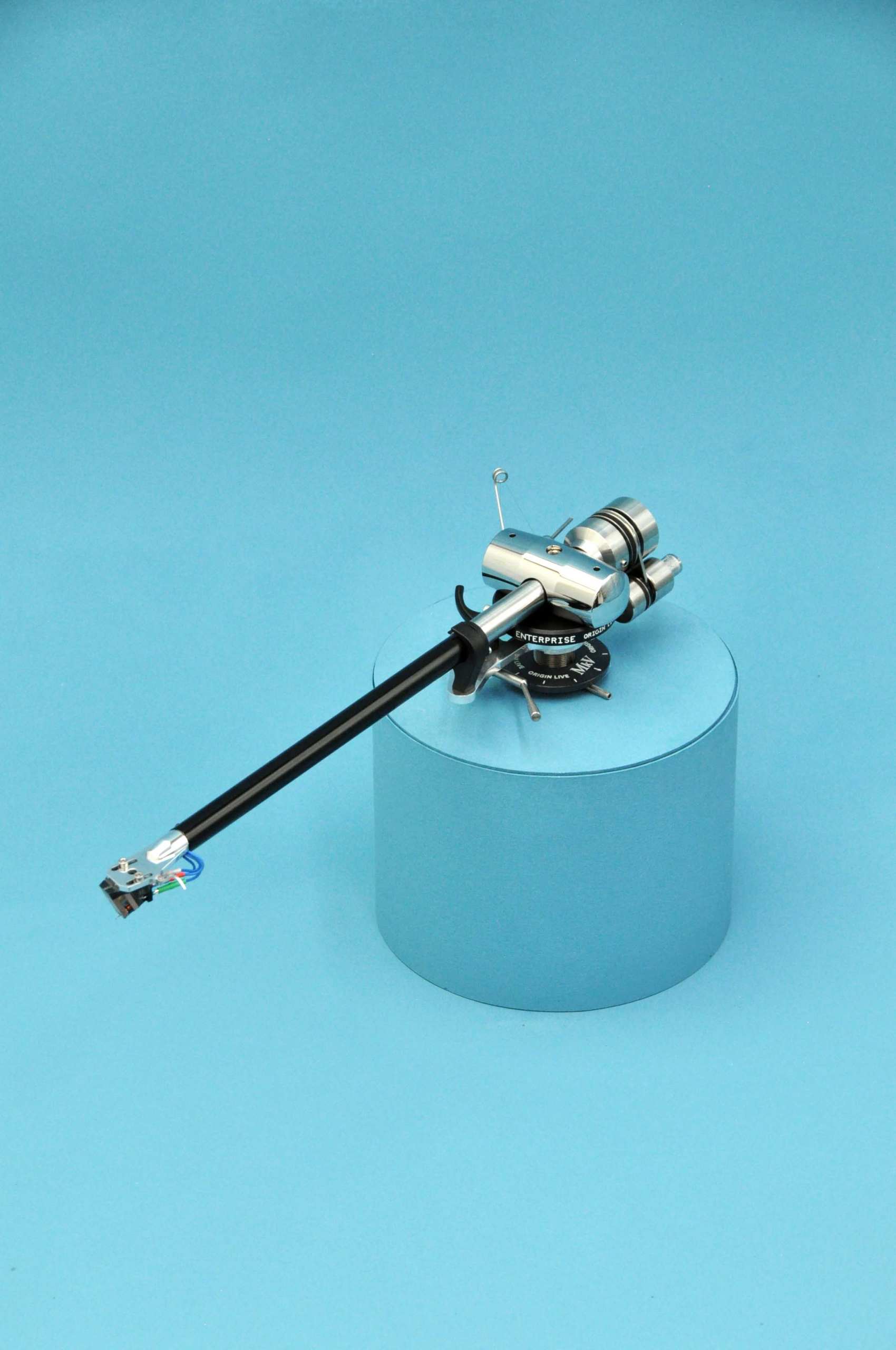
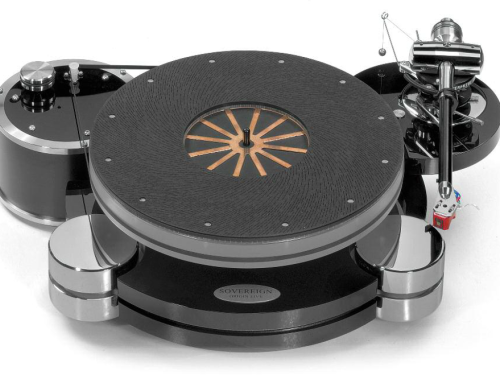
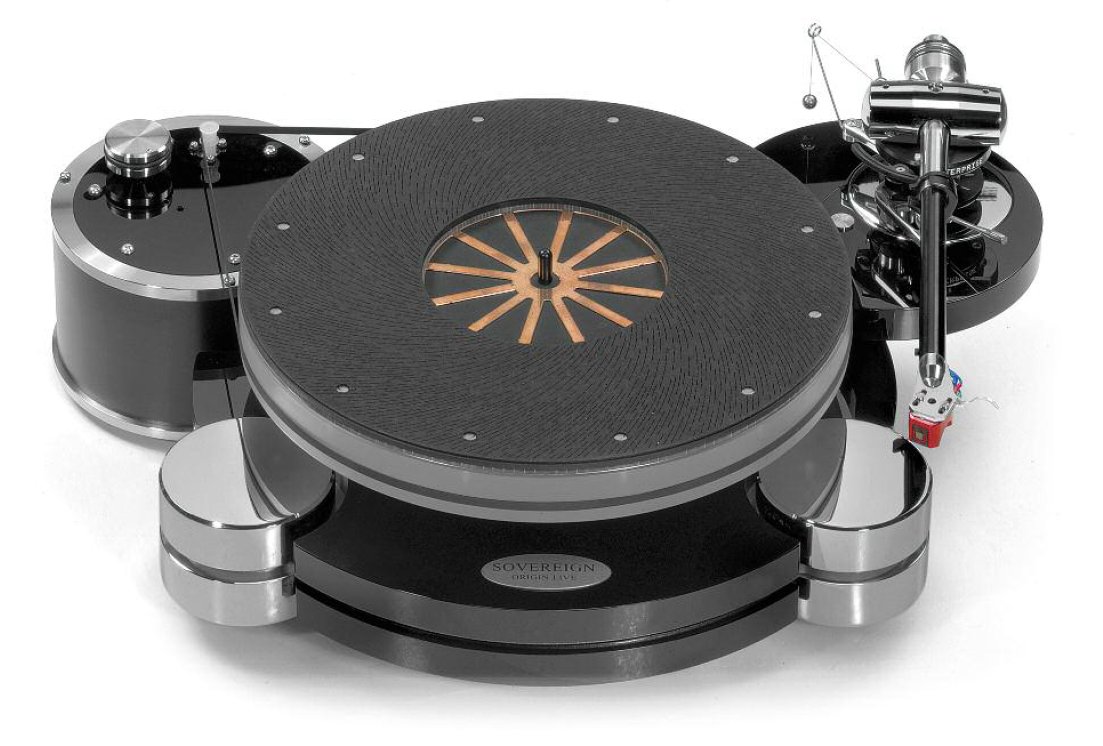
System one: an Origin Live Calypso turntable and Illustrious tonearm with one of our tonearms, around £3,500 at the time of demo, fitted with a £400 cartridge.
System two: an entry-level Pro-ject Juke Box £200 turntable/tonearm combo fitted with the Lyra Atlas, an £8,000 reference cartridge.
Same record, same downstream electronics. The room was unanimous. The cheaper cartridge in a better tonearm and turntable sounded substantially better.
This isn’t an argument against good cartridges. The Atlas is a remarkable piece of engineering. It’s an argument about where in the vinyl playback chain your money does the most work.
The scale problem
To understand why, you have to grasp the scale at which a stylus operates, and how easily it can be interfered with.
A record groove is roughly 40 microns across, about the thickness of a human hair. Within that groove, the stylus is detecting movements as small as a micron at frequencies up to 40 kHz. The signal it produces is then amplified roughly 8,000 times before reaching your speakers.
A useful way to visualise this: imagine placing a supermarket carrier bag on top of Mount Everest, then magnifying the bag until it’s the size of the mountain. Any tiny crease, any minor imperfection in the bag is now reproduced at the scale of an entire geological feature.
That’s the amplification factor your tonearm operates inside. Any vibration, any flex, any unwanted movement the tonearm contributes gets magnified by the same 8,000 times the music does.
The cartridge should theoretically be able to produce a perfect transcription of the groove, but that is never the case. every unwanted vibration, whether that’s in the tube, the friction of the bearing or an unstable application of side bias produces vibration that interferes with the cartridge and the signal it is generating. This in turn results in smearing in the music you listen to.
Arm tubes as they vibrate and resonate, actually flex and move, which is bad news for the accurate tracking of a groove. Think about it this way:
The clock gauge on a fishing rod
In engineering we use a clock gauge, an instrument that measures distance in microns. Mounted on a rigid surface it gives precise, repeatable readings. Mounted on the end of a fishing rod while the rod waves about, the readings become meaningless. The gauge is still accurate. The reference point isn’t stable.
A stylus is a mechanical instrument. A tonearm is what holds it steady. If the arm flexes, twists, or vibrates while the stylus reads the groove, the cartridge can’t tell which movements came from the record and which came from the arm. The signal is contaminated before it ever leaves the cartridge.
This is why rigidity is the first principle of tonearm design. When the stylus hits a sharp transient like the leading edge of a bass note, that energy tries to push the whole arm backwards. If the arm flexes even slightly, energy that should have become signal becomes flex, and you lose dynamics. Bass disappears first.
Resonance: the wrong measurement
Magazines often quote a tonearm’s resonant frequency, with an ideal around 10 Hz. The implication is that an arm with the “right” frequency is a good arm. This misses the more important measurement.
Every tonearm resonates. It’s a spectrum, but no material is genuinely rigid at this scale, not titanium, not carbon fibre, not the densest hardwood. The question isn’t whether your arm resonates. It’s how much it moves when it does.
Theoretically, an arm perfectly resonating would actually stay still at its ends – in perfect resonance, no matter what the frequency, the cartridge would remain still. Of course, this isn’t how things work in practice, but the important thing to note is that resonance itself isn’t the issue. what matters is how great the amplitude reaching the position of your cartridge is.
We’d rather have an arm that resonates at an “imperfect” frequency but moves only a tiny amount, than one with a textbook 10 Hz resonance that flexes by a larger amplitude. The frequency is what reviewers measure. The amplitude is what your cartridge actually has to cope with.
Where the energy goes
When the stylus excites the arm, vibration travels down the tube toward the bearings and the counterweight. Most of it hits the counterweight at the back, and because the counterweight is heavy, some of that energy reflects straight back up the tube into the cartridge. The cartridge is trying to hold itself steady to read the groove. A reflected wave through its mount fights that effort and smears the signal.
The conventional fix is a single solid weight on the rear stub. We do something different. On our high-end arms from Illustrious up, we not only use a hollow mass-effective rear sleeve, but our counterweights are built from multiple layers of dissimilar materials, designed to absorb rather than reflect. Our current design uses 22 separate components and took years to develop. Multi-layer counterweights are now appearing on competing arms, usually a sign that an approach is working.
The materials trade-off
There is no perfect tonearm material. Titanium is rigid but rings at higher frequencies, giving beautiful midrange and treble but weak bass. Soft cast aluminium, used in many entry-level arms, rolls off the top end and loses dynamics. Carbon fibre is genuinely good and currently fashionable, but treated as a single-material solution, it doesn’t solve the underlying problem.
That problem is this: rigidity and damping fight each other. You want the arm rigid enough that the stylus reads cleanly. You also want it to dissipate vibrational energy quickly, so reflections don’t return to the cartridge. Add too much damping, and you lose some frequencies while others travel through and reflect back at different times, creating a timing smear you can hear in the music.
After thirty-plus years of experimentation, our conclusion is that no single material does it all. Our current arms use combinations of multi-layer tube construction, specialist coatings, and internal damping, because each frequency band responds best to a different solution. There is no magic material, only careful trade-offs handled at every level of the structure.
What this means for your system
The cartridge is not where most of the audible difference in vinyl playback lives. The tonearm and turntable are. If you’re upgrading a system and your budget is finite, the tonearm is almost always where the next pound is best spent. It’s the unfashionable answer, but its the honest one.