BLOG POST
Tonearm Bearings: The Job, and Why It’s So Hard to Get Right
Small job, big impact
A tonearm bearing has one of the smallest jobs in a hi-fi system and yet, one of the most consequential. It has to let the arm pivot freely while the cartridge reads movements measured in microns at 2-4 tonnes of pressure, up to 40,000 times a second. Get it seriously wrong and everything downstream is compromised: timing, tracking, dynamics, imaging, the lot.
After forty years of building, modifying, and rewiring just about every arm on the market, we’ve had a lot of experience with all sorts of bearings up close, as well as discussing many bearing systems with their designers face to face at hifi shows. We’ve compiled our thoughts on different tonearm bearings below.
What a bearing has to do
Four requirements, in tension with each other. Every design is a compromise between them.
Low friction. Records are rarely perfectly centred, so the arm tracks in and out continuously as the platter rotates. Beyond that, the groove itself demands free movement up and down from the tonearm to allow the cartridge to stay central in the groove, as it tracks a 3-dimensional, modulated waveform in much the same way a mogul skier might traverse a mogul field. A high-friction bearing can’t keep up with the demands of this movement, resulting in smeared transients in your music. The stylus drags against the groove instead of riding it, sidewall pressure rises, and record wear accelerates.
Friction: Stiction. Stiction is a type of friction that is another fundamentally important part of tonearm bearing design. Like friction, stiction relates to freedom of movement, namely, peak static friction. This is the force required to initiate movement between two stationary objects; here, it is how easily the tonearm, mounted with a cartridge, allows the bearings to move as the vinyl plays. It is crucial in the tonearm to have low-stiction bearings which can easily move and react to dynamic passages in the music pressed on your vinyl. The highest stiction means the tonearm gets… stuck. High-stiction bearings move very sluggishly and cause tracking errors with the cartridge. Even if it’s not heard in skipping or channel imbalances, high-stiction bearings limit the cartridge’s free movement and tracking. This limits the overall system’s fidelity and damages transients in every respect. Low stiction allows for a fast reaction to dynamics and transitions, benefiting all aspects of the music. The lower the stiction, the better; the higher the stiction? expect to be hearing smearing.
Rigidity. This sounds like a contradiction with low friction, but it isn’t. The bearing should rotate freely around its intended axes and resist everything else. We’re talking about play measured in microns, which sounds trivial until you remember the scale of what the cartridge is tracking and how it amplifies those movements by a factor of thousands. A bearing with even slight backwards-and-forward play introduces shockwaves into the arm every time the stylus hits a transient. This can be improved by adding mass in the right areas and by using some engineering know-how to determine where and how the pivots are placed.
Energy transfer. All tonearms vibrate, at some level. A key task is getting vibration in the arm to leave and, importantly, not to reflect back. The bearing is one of the main exit routes, and also a potential entry point for vibration from the turntable. So which matters more? In an ideal world, you’d want a joint that lets energy flow in one direction but not the other. Some designers will tell you that’s impossible. We disagree: bearings genuinely exhibit asymmetric behaviour depending on their design and geometry, and the right balance depends on the rest of the system. A well-isolated turntable lets you prioritise extracting energy from the arm. A noisier deck pushes you toward keeping energy from getting in.
Reliability. A well-built tonearm should last fifty years or more. We still see arms we built three decades ago performing as they did the day they shipped. Unreliability can creep in through poor-quality components or sloppy assembly, causing components to drift out of alignment over time or fail altogether.
The main families
Gimbal bearings: small ball races on perpendicular axles, the type used in skateboards and countless other applications. Most of the industry uses them. We do too, across our entry-level models, because when they’re done properly, they work very well. The catch is “done properly”: ball size, steel grade, cage design, race smoothness, and tolerance class all matter, and they all sound different. Ball bearings can be high-stiction and harder to move. This is why we specify our own bearings rather than buying them off the shelf, to ensure they are not overly tight and the stiction stays as low as possible.
One detail worth mentioning: where the gimbal sits matters as much as how it’s built. Rega’s arms place the bearings inside the arm tube. When we started modifying Rega tonearms in the eighties, the single most effective change we made was relocating the bearings into the yoke, outside the tube. Bearings vibrate. You don’t want that vibration happening inside the part of the arm carrying the signal.
Uni-pivot bearings: a single spike resting in a cup. Beautifully simple, cheap to manufacture, and inherently low-friction and low-stiction. It dominates the budget end of the high-performance market for good reason. The downsides are real, though: the spike is vulnerable to damage, and a single point can’t constrain rotation around the arm’s own axis, so designers compensate by hanging the counterweight well below the pivot, or in the worst cases, using high-friction cones to stabilise the pivot. Setup is notoriously fiddly, and this bearing type cannot remain stable in the azimuth plane,
There’s a clever variant where the spike locates against three small ball bearings instead of a flat cup floor. Friction increases, but rigidity improves dramatically, and vibration is transmitted out of the arm more effectively. Whether the trade is worth it depends on what you value.
A recent breakthrough in this area has been the SUPATRAC tonearm, which uses a sideways unipivot, meaning the arm’s pivot is locked against the drag of the groove, and cannot shift backwards and forwards during playback. It’s an ingenious design by an ingenious designer and friend. For the SUPATRAC philosophy, it is a coherent design. To achieve our own design goals, however, we employ a dual-pivot bearing.
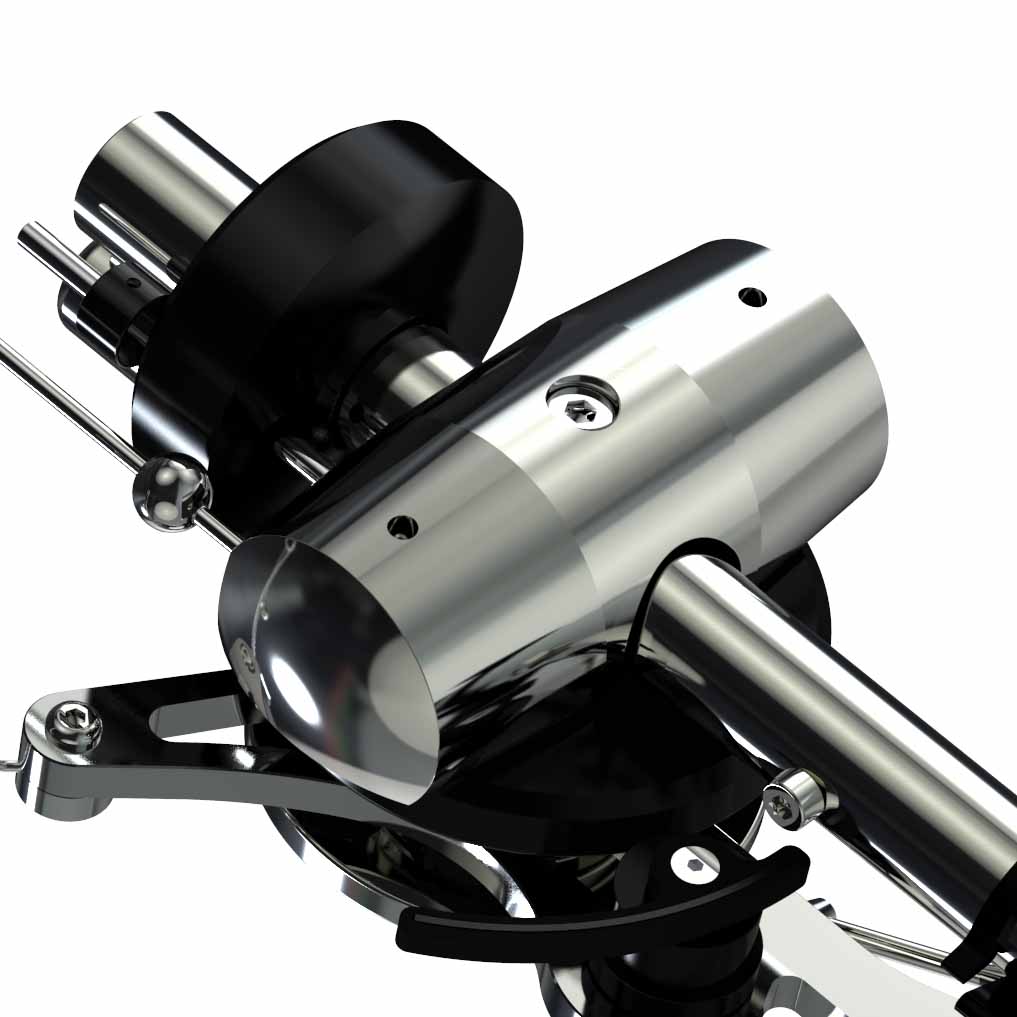
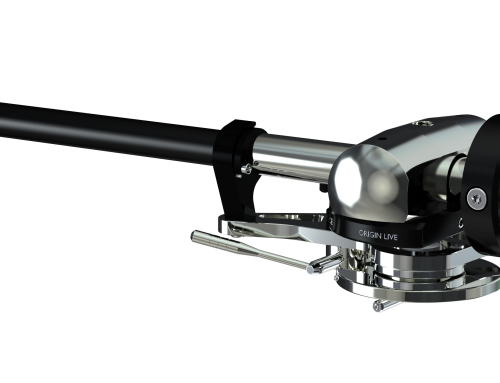
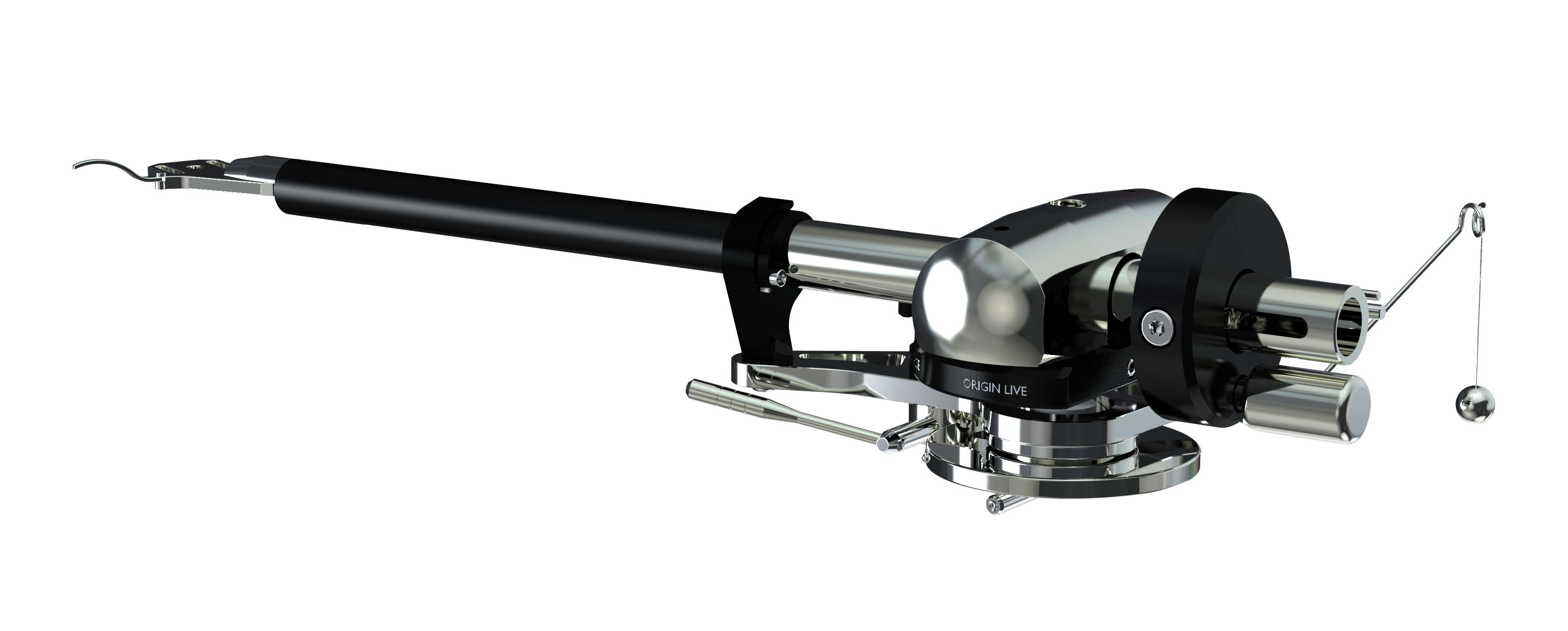
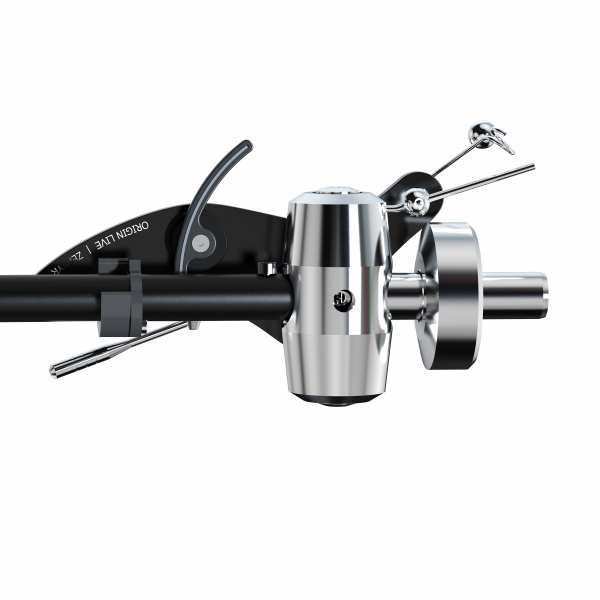
Dual pivot bearings: What we use across our premium and high-end tonearm ranges. Two points into two cups, either side of the armtube handle vertical movement; conventional gimbals on the same plate handle horizontal rotation. You get the low-friction energy-transfer characteristics of point contact on the vertical axis, the stability and easy setup of gimbals on the horizontal, and adjustable azimuth as a bonus. The other interesting thing about this bearing type is the ability to mass load the pivot and add inertia to all axess.
Is the hybrid a compromise? Deliberately so. No single bearing type wins on all four requirements. A well-executed ball race outperforms a poor uni-pivot; a well-executed uni-pivot outperforms a mediocre ball race. Combining them lets each do what it does best.
Interestingly, three manufacturers in Europe: Kuzma, Moerch and Origin Live, independently arrived at the dual-pivot idea around 15 years ago. Nobody copied anyone. The bearing system just makes sense once you’ve spent enough time with the alternatives.
The exotic options, briefly
Ferrofluid-floated bearings: The arm floats on a bed of magnetic fluid, supposedly decoupling it from the arm board. The decoupling claim doesn’t really hold up. magnetic fluids, magnetic fields, air, and string all transmit vibration. Everything does, to some degree. There are no isolation barriers in this world, only better and worse compromises. This entails a fundamental lack of rigidity that prevents proper tracking of the record groove.
Hanging-thread bearings. The Schröder approach: the arm hangs from a high-tensile thread, sometimes with a paddle dipped in ferrofluid for damping. Genuinely ingenious, excellent freedom of movement. The practical challenge is controlling sway during cueing. Clearaudio’s variant uses a small magnet beneath the arm to stabilise it.
Magnetic bearings. The arm is held between opposing magnets, with nothing solid contacting it. Zero mechanical friction in the bearing itself, but that just throws the spotlight on a point most people miss:
On a well-designed gimbal arm, the arm cable accounts for roughly 70% of the total friction in the bearing system. The bearings themselves are a minority of the horizontal torque problem.
That figure changes how you think about everything. It’s why cable routing matters as much as bearing choice. We hold the cable hole in our yokes to 2mm; even 3mm measurably increases friction, because the cable starts to wander off-axis and create leverage on rotation. It’s also why we route the cable internally. An external run picks up RF, and we’ve measured radio interference even with as little as 4 inches of unshielded cable.
Air bearings. Almost exclusively used on linear-tracking arms. They elegantly solve the tracking-error problem, but linear trackers have inherent issues: the effective mass is high because the entire assembly has to translate sideways, not just pivot. Some well-known designs run at 70g effective mass, which has uncomfortable implications for long-term record wear. A reasonable target is 25–30g — achievable, but the rest of the engineering is hard.
One of the larger issues here is keeping the air pressure genuinely constant and captive. Most air bearing designs have open sides that leak air pressure and allow horizontal play. Another issue here is how the cabling and air hose interact with the moving assembly – these are likely to introduce unwanted forces in the horizontal plane.
Flex bearings. A thin, flexible membrane that bends rather than pivots. The advantage is the elimination of stiction: the slight extra friction required to get a stationary bearing moving. The trade-off is rigidity: to flex easily, the membrane has to be thin, and that thinness also allows vibration in both directions.
What to avoid
A short list of bearings we’d steer clear of as a buyer:
- Horizontal-point bearings (two spikes pointing outward from the arm tube into cups). The assembly pressure required to keep the spikes located feeds vibration straight into the tube. We’ve tried it. It sounds poor.
- Knife bearings (a knife edge in a V-groove). Effectively obsolete. Reliable forever, but the contact area is enormous, and it fails on three of the four requirements simultaneously.
- Ferrofluid-decoupled bearings, for the reasons above.
For everyone else, a general principle: if you don’t want to spend setup time fussing with azimuth and balance, a well-made conventional gimbal is the most user-friendly bearing of the lot. There’s no shame in that; it’s part of why gimbals remain on so much of our range.
In terms of absolute performance, we believe Dual-Pivot excels in all of the listed areas, which is why you’ll find them on the premium and high-end side of our range.
The point
Bearings, like every other element of tonearm design, are about execution. There is no single “best” type. What matters is how well the chosen approach is realised: bearing quality, placement, cable management, and the mass & rigidity of everything around it. The job isn’t to chase a theoretical ideal off the track; it’s to understand the compromises clearly enough to find the best solution, and the other design opportunities that bearing allows.
Tonearm Ranges
For many years, Origin Live Tonearms have earned the highest praise from satisfied owners, and are acclaimed by editors and reviewers as the best they have ever heard.