BLOG POST
9″ vs 12″ Tonearms: the Difference Isn’t What You Think It Is
Not just tracking error
If you’ve ever asked why longer tonearms are supposed to sound better, you’ve probably been told the answer is tracking error. A longer arm traces a flatter arc across the record, so the cartridge sits closer to perpendicular with the groove, and distortion is lower. This is because when records are cut, the cutterhead travels in a straight line across the lacquer’s surface. When using a pivoted tonearm with a stationary base, the cartridge on the arm actually travels in an arc, across the record, not a straight line. So… The longer the arm, the straighter the arc the cartridge travels through, right?
It’s a clean story. It’s also, in our view, almost entirely the wrong reason.
The actual peak difference in tracking distortion between a well-aligned 9.5″ arm and a 12″ arm is around 0.5%. That’s the difference in total harmonic distortion measured at the worst point on the record, the inner grooves, where common cartridge alignments like Lofgren and Baerwald are the least forgiving. Across most of a side, it’s far smaller at 0.15-0.2% difference
Yet, for the first two-thirds of a record, where the difference in distortion is tiny, 9.5″ and 12″ actually sound distinctly different.
A 0.5% difference is not what people are hearing when they describe a 12″ arm as smoother, more relaxed, and weightier in the bass. Something else is doing that work. After decades of building both lengths of models of the same arm, we think the real story is inertia.
What people actually hear
Before getting into why, it’s worth being clear about what the sonic difference between the two actually is, because the trade-off is real, even if the explanation usually given for it isn’t.
A 9.5″ arm tends to sound faster. Quick transitions are navigated deftly. There’s more attack, more punch. Music has a sharper leading edge. It can also sound a touch harsher, depending on the cartridge and the system.
A 12″ arm sounds smoother and more relaxed. There’s more bass weight, more sense of ease, and detail. Some listeners find this more musical. Others find it slightly less immediate and lacking in the bite they might need for their listening preferences.
Most listeners hearing the actual differences prefer the 12″ arm. But it’s a preference, not a clear technical win, and there are genres and systems where the shorter arm is the better match. Rock, pop, hard bop jazz, and anything that lives on attack and dynamics often comes alive on a 9.5″. Classical, vocal, and music that depends on tonal weight and ease often favours a 12″.
Why 12″ tonearms don’t solve tracking error
A 9.5″ arm and a 12″ arm both sweep an arc across the record because both are pivoted. Neither tracks in a true straight line. The difference is that the 12″ arm’s arc is slightly flatter, so the cartridge sits at a smaller angular error relative to the groove tangent at most points on the record.
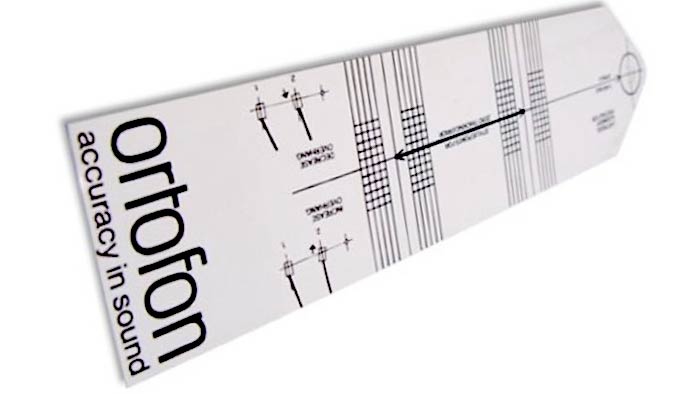
The two arms have two “null points” each, where the cartridge sits exactly perpendicular to the groove. Between and outside those points, both arms have some error. The 12″ arm’s worst-case error is smaller, but only by enough to produce around 0.5% less distortion at the worst point on the record.
That figure is the heart of the problem with the conventional explanation. A 0.5% difference, present only at the inner grooves, cannot account for sonic differences that are obvious within a few seconds of listening across the whole side of a record. Something larger is going on.
Inertia is the larger thing
Rotational inertia is an object’s resistance to rotation. For a tonearm, the relevant formula is I = m × r². The inertia is proportional to the mass times the square of the distance from the pivot.
That squaring matters. Doubling the length of an arm quadruples its inertia at constant mass. Going from a 9.5″ effective length to a 12″ effective length increases rotational inertia by around 60%, even before accounting for the fact that 12″ arms are usually heavier as well.
Inertia is the tonearm’s resistance to being pushed to the side when your cartridge’s stylus is tracing the groove. The cartridge needs a stable reference point to read the groove against. If the arm has too little inertia, the arm itself moves when the stylus does, and the cartridge can’t tell the two motions apart, resulting in smearing. If the arm has greater inertia, it sits more firmly in the groove, and the cartridge reads more cleanly.
This is also why higher-inertia arms tend to deliver better bass. The lowest frequencies require the most energy from the cartridge, and the arm has to hold steady against that energy. A longer arm holds steadier, almost regardless of how well it’s designed in other respects.
There’s a related point that’s almost never discussed: the side force needed to deflect a longer arm is lower than for a shorter one. The mechanics of leverage mean a 12″ arm offers less resistance to lateral movement at the cartridge end, even though it has more inertia overall. The combination of high rotational inertia and low applied side force is part of what gives longer arms their characteristic ease of use. This also means less anti-skate is being applied, resulting in less added, potentially disruptive, force being applied to the arm (especially with worse side-bias mechanisms).
What to actually buy
This is the question we get most often. The short answer: a well-designed 9.5″ arm will beat a poorly-designed 12″ arm every time, and it isn’t close.
Arm length is one factor in a long list of factors that determine how a tonearm performs. Bearing design, tube construction, internal damping, counterweight design, and a dozen other variables matter more than the choice between 9.5″ and 12″. The length difference is real, but it sits below most of those other variables in order of importance.
The practical implications:
If your turntable can only accommodate a 9.5″, don’t lose sleep over it. You can build an extraordinary system around a good 9.5″ arm.
If you can fit either, and your budget is fixed, it’s usually better to go up the range with a more sophisticated 9.5″ than across to a 12″ lower in the range. A more sophisticated 9.5″ arm will generally outperform a less sophisticated 12″ arm, even though it has the advantage in length. Often, the features employed to handle vibration in a more sophisticated arm are audibly more important than the benefit of length.
If your budget allows both, our own preference is the 12″. We find it more relaxing, more musically accessible, and easier to listen to over long sessions. But this is a preference, not a verdict, and a serious listener with a rock-heavy collection might reasonably come down the other way.
The thing that matters most is not the length. It’s the design.
Tonearm Ranges
For many years, Origin Live Tonearms have earned the highest praise from satisfied owners, and are acclaimed by editors and reviewers as the best they have ever heard.